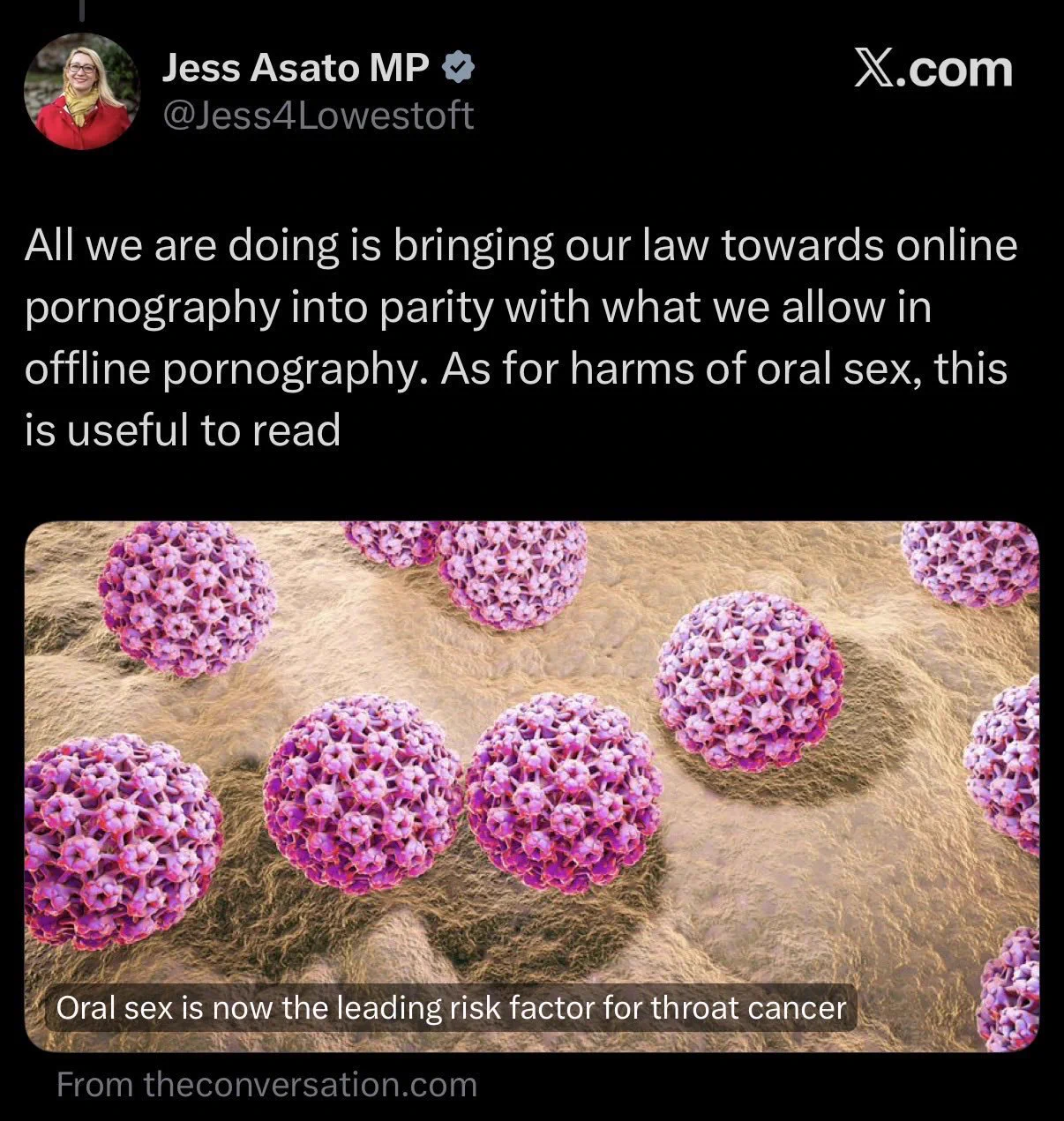
A recent social media post by political commentator Tom Harwood has ignited a fiery debate about Labour MPs, sexual freedoms, and the role of government in private matters. Harwood's claim that Labour MPs are 'trying to ban oral sex' has sparked outrage, confusion, and a fair amount of humor online. But is there any truth to this accusation, or is it a case of misinformation and moral panic?
The Spark of Controversy
The controversy began when Labour MP Jess Asato shared an article highlighting the increased risk of certain cancers associated with oral sex, particularly in individuals with multiple sexual partners. Asato's intention, as she clarified, was to bring online pornography regulations in line with offline standards and raise awareness about potential health risks. However, Harwood's interpretation of her comments as an attempt to 'ban oral sex' quickly gained traction, leading to a wave of criticism and ridicule.
Misinformation or Moral Panic?
Many online commentators were quick to dismiss Harwood's claims as baseless. 'This is just completely false,' one person stated, 'no one’s trying to ban oral sex... it’s just sound medical advice.' Another pointed out the absurdity of the situation: 'I like that one MP sharing an article... is enough to write a polemic decrying that “Labour MPs are trying to ban oral sex”, which is not happening nor being proposed.'
Despite the lack of evidence supporting a ban, the debate has raised questions about the role of government in regulating private sexual behavior. 'Why does anyone give a shit what people do in the privacy of their own homes?' asked one exasperated commenter. 'If I want to guzzle cocks non-stop for 12 hours I should bloody well be able to.'
The Politics of Sex
The discussion has also shed light on the broader political landscape, with some drawing parallels between Labour's current stance and historical conservative moral panics. 'We're bringing back sodomy laws, chaps,' Harwood quipped, echoing concerns about a rollback of sexual freedoms. Others criticized the Labour Party for what they see as a shift towards puritanical policies, with one commenter noting, 'All the parties at the moment are completely F'ed up and nobody seems to remember what their party ever stood for to begin with.'
Amidst the debate, there were calls for a more nuanced approach to sexual health and education. 'I think an argument can be made for ensuring we have comprehensive sex education that includes talking about using condoms and latex barriers for oral sex,' suggested one commenter, highlighting the importance of informed consent and risk awareness.
The Search for the 'Sex MP'
In a lighter vein, the controversy has also inspired a search for the hypothetical 'sex MP'—a politician willing to champion sexual freedoms and challenge puritanical attitudes. 'We need a volunteer to be the 'sex MP',' joked one person, with suggestions ranging from Sutton to Bicester, humorously renamed 'Bi-Cester' for the occasion.
Conclusion: Freedom, Responsibility, and Common Sense
As the dust settles on this heated debate, it's clear that the issue is not about banning oral sex but about how we discuss and regulate sexual behavior in the public sphere. While concerns about health risks are valid, the reaction to Asato's comments underscores the importance of clear communication and the dangers of misinformation.
In the end, the debate serves as a reminder that sexual freedom is not just about the absence of restrictions but also about fostering a culture of responsibility, education, and respect. As one commenter wisely noted, 'What people do behind closed doors is their own business as long as it isn't harming anyone.' Perhaps this is the common-sense approach we need to navigate these complex issues without resorting to moral panic or misinformation.
